Analysing Nintendo 64 Success with Microsoft Excel
Data LabFirstly released in 1996 in Japan, the Nintendo 64 was a successful video-game console. It came at a time when the video-game sector transitioned from 2D games to 3D games, and laid the foundations of 3D gameplay. In addition, several games were developed around precision skills and freedom of movement. Lastly, the console made possible to play at 4 players without any additional accessories.
Thanks to a dataset available through this link: https://www.kaggle.com/datasets/nicholasconsiglio/nintendo-64-sales - I found it relevant to extract valuable data with Microsoft Excel to explain why the Nintendo 64 was successful?
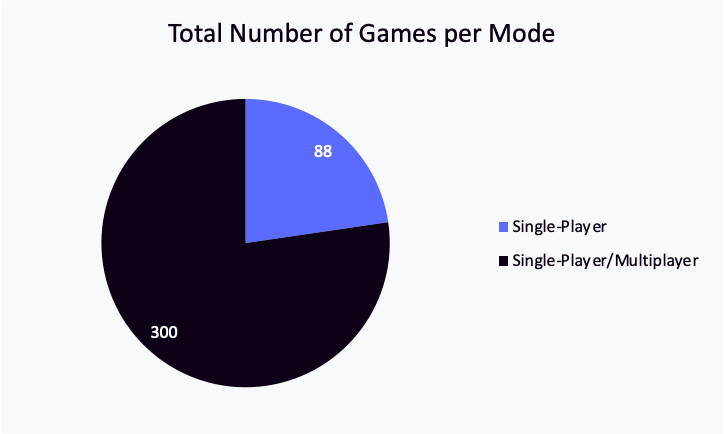
One of the most striking indicators we can identify is the number of games with multiplayer features. Of the 388 games released, 300 had this option — more than 75%. As mentioned above, the console had the capacity to support four players without the need to purchase additional accessories.
This had a direct impact on sales, as the units sold were massively multiplayer games.
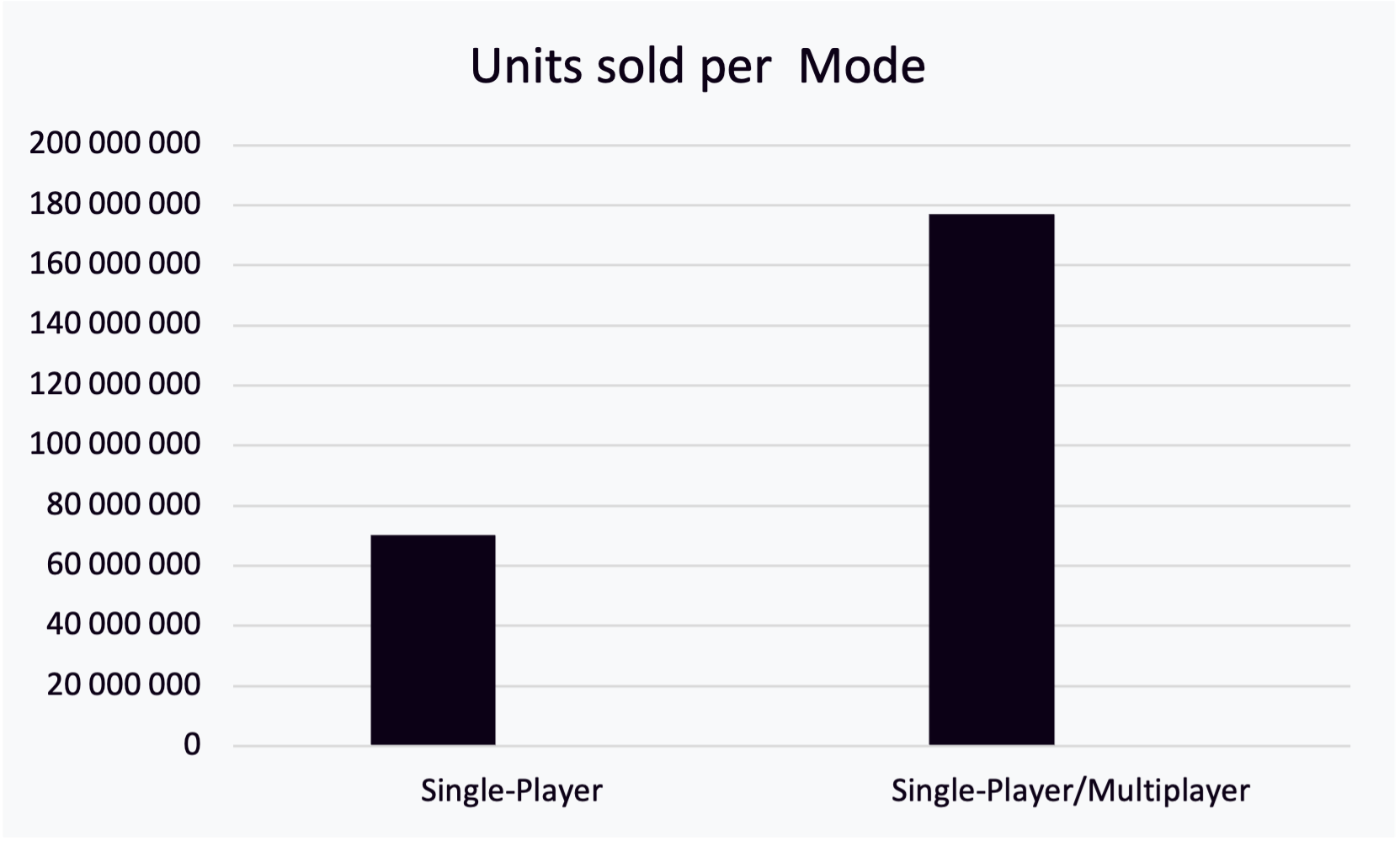
Posing as each were sold at $60, we might estimate and transform these numbers to calculate the volume of revenue and the definitive impact of multiplayers on sales. Of course, we don't take into account the fact that some games had their price evolved (special edition, bundle, etc.):
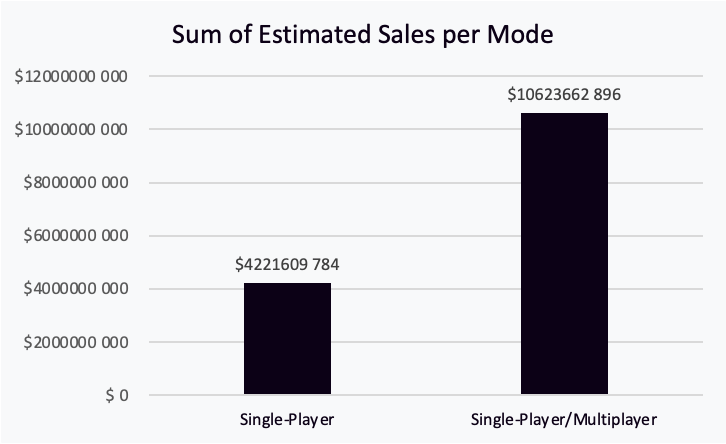
As expected, multiplayer games generated the majority of revenue for the Nintendo 64 console. Based on a standard unit price of $60, sales could represent up to $14.85 billion in revenue. Multiplayer games alone accounted for around $10.62 billion of this.
A total of 388 games were released on the Nintendo 64, with 1999 seeing the highest number of releases in a single year. This represents almost 30% of global releases.
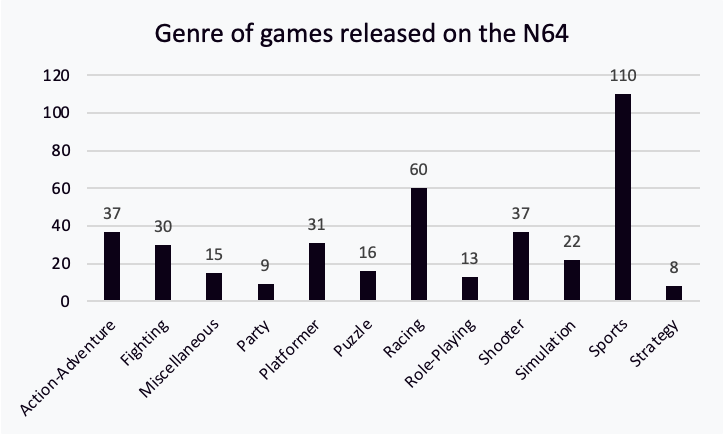
Throughout its five-year lifespan, a wide variety of games aimed at audiences ranging from young children to adults were released by publishers. This broad appeal meant that players of all ages could enjoy multiplayer experiences for much of the time. As shown in the graph above, developers focused primarily on sports games.
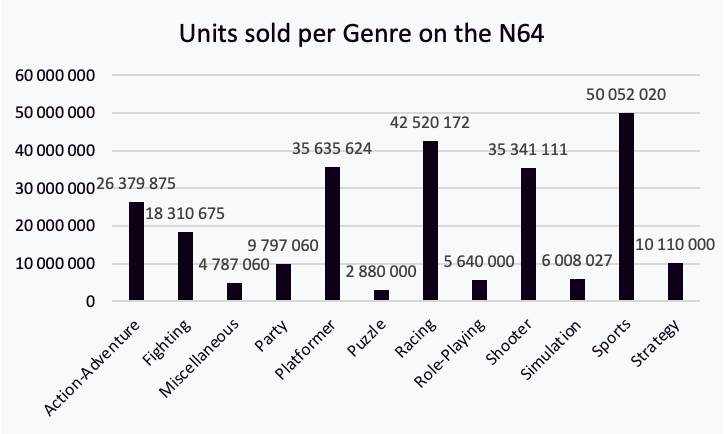
The graph below shows the number of units sold per genre, confirming the developers' decision to prioritise sports games, which top the graph, while also demonstrating the popularity of racing games.
To further demonstrate the success of the Nintendo 64, let us take a look at the ESRB ratings of each game. The ESRB (Entertainment Software Rating Board) is a self-regulatory organisation that assigns age and content ratings to consumer video games in Canada, the United States and Mexico. These ratings include categories such as E (Everyone), E10+ (Everyone 10 and over), T (Teen) and M (Mature), which help parents to determine whether a game is suitable for younger players. Many popular Nintendo 64 titles, including Mario Kart 64.
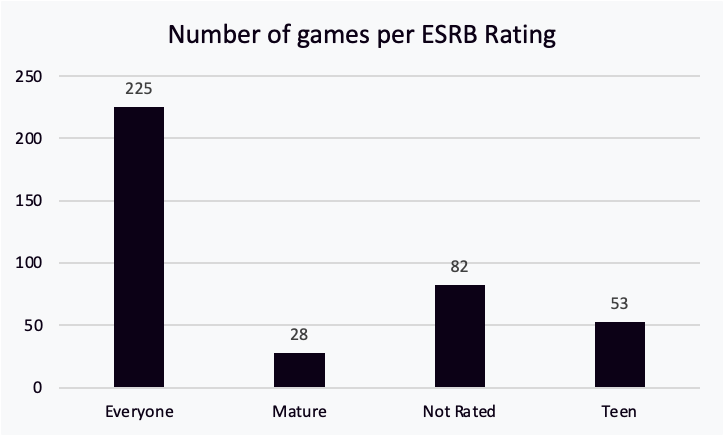
As shown in the graph, more than half of the games released on the Nintendo 64 received an 'E' rating, while only 28 received an 'M' rating.
Some Nintendo 64 games were not rated by the ESRB for a variety of reasons. Firstly, the timing of the ESRB's establishment meant that some early or niche titles were released before ratings were consistently applied. Secondly, games with limited or regional releases, particularly outside North America, sometimes did not undergo the ESRB process. Thirdly, as ESRB ratings are voluntary, certain publishers chose not to submit their games due to budget constraints or because they felt the content was clearly suitable for all ages. Finally, re-releases or special editions of games sometimes bypassed individual ratings, particularly when included in compilations or promotions.
In conclusion, the Nintendo 64 enjoyed success for two main reasons. Firstly, its native multiplayer features and components encouraged developers and publishers to release multiplayer games, most of which had an 'E' rating. Secondly, the console benefited from the transition from 2D to 3D video games, offering players a more immersive experience.